
bhARaT
THE ART OF UNITY I
Dr. Ashish Sharma
2026
Mixed media on canvas (acrylic, clay and mirror work)
24 × 36 in. (61 × 91.4 cm)
ABOUT THE ARTWORK
Centered upon a vibrant, map of India, Ganesha - serves as a unifying presence in this exploration of cultural identity, artistic heritage, and Indo-U.S. friendship. The Indian tricolor and American stars and stripes are integrated into the figure, bringing symbols of the two nations together within a single form.
Surrounding the map, traditional Indian art forms from different regions of the country are integrated. Madhubani appears in the upper left, while Lippan-inspired clay and mirror work occupies the upper right. Gond motifs animate the lower left, Pichhwai imagery appears at the lower center, and Warli figures at the lower right evoke community and collective celebration. Mandala-inspired patterns radiate around the map, visually connecting these distinct traditions and reinforcing the idea of unity within diversity.
At the right of the map appears her signature style 'Alphabet Ganesha', an artistic practice in which written characters are not simply placed within an image of Ganesha - the letterforms themselves are composed to create the form of Ganesha. In this work, the Devanagari letters भारत (Bharat) are rendered in the colors of the Indian tricolor, while the letters USA carry the colors of the American flag. Together, language becomes image, identity, and symbol.
Through traditional Indian art, contemporary mixed media, language, spirituality, and national symbolism, bhARaT - The Art of Unity celebrates India’s cultural richness while creating a bridge between India and the United States. The work presents diversity not as separation, but as a source of connection - many traditions, languages, and identities brought together as one.
ALPHABET GANESHA — LANGUAGE BECOMES FORM
भारत — USA
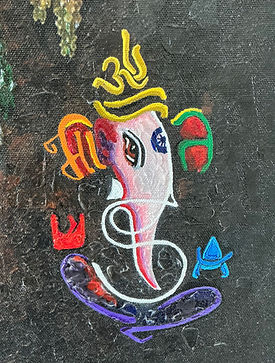
Alphabet Ganesha is Sharma’s signature artistic practice, transforming written language into visual form.
In this work, Devanagari ॐ (OM) adorns as the crown and Devanagari letters भारत (Bharat) are rendered in the colors of the Indian tricolor, while the Latin letters USA carry the colors of the American flag. Together, the two writing systems form a single Ganesha, bringing language, image, and cultural identity into one composition.
This expression reflects the idea at the heart of Sharma’s continuing “One Form – Many Languages” practice: different languages and scripts retain their individual identities while finding unity through a shared form.
EXPLORE THE TRADITIONS

MADHUBANI
Originating in the Mithila region of Bihar, India, Madhubani art is known for intricate patterns, vibrant colors, and imagery drawn from nature, mythology, and everyday life. Here, peacocks, an elephant, and the sun evoke its richly decorative visual language.
PICHHWAI
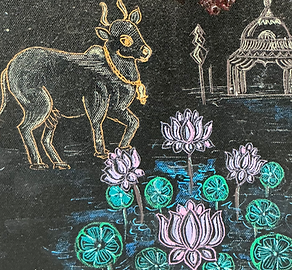
Originating in Rajasthan, Pichhwai painting is traditionally associated with devotion to Krishna and is known for imagery of cows, lotuses, nature, and the temple settings. Here, the cow, lotus pool, and architectural elements evoke this devotional visual tradition.

LIPPAN
Lippan is a traditional mud-and-mirror art associated with the Kutch region of Gujarat. This interpretation uses raised clay lines and embedded mirrors to create geometric patterns that reflect light and bring texture and dimension to the canvas.

WARLI
Warli art, associated with the Warli communities of western India, uses simple geometric figures to depict village life, nature, ritual, and the community. Here, figures gathered in rhythmic movement evoke celebration, collective life, and the relationship between people and their surroundings.

GOND
Rooted in the artistic traditions of the Gond communities of central India, Gond art often transforms animals and natural world through rhythmic patterns, dots, and lines. Here, a peacock and branching foliage are formed through intricate dotted ornamentation.

MANDALA-INSPIRED
Drawing upon the geometry and the symbolism of the mandala, these concentric patterns suggest balance, continuity, and connectedness. Within the composition, they radiate around the map of India, visually connecting the work's diverse cultural and artistic elements.
ABOUT THE ARTIST
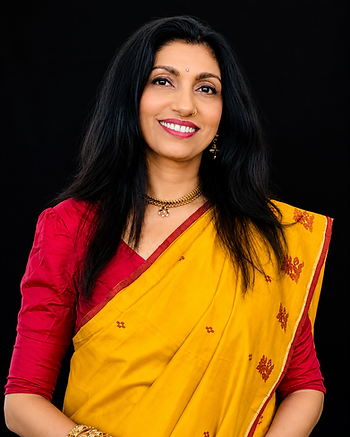
Dr. Ashish Sharma is a multidisciplinary artist whose work explores the intersections of language, spirituality, cultural heritage, and visual form. Since January 1, 1991, she has sustained an uninterrupted daily artistic journey centered on Ganesha, creating thousands of works over more than three decades.
At the heart of her work is Alphabet Ganesha, where letters and scripts evolve into the form of Ganesha. Her continuing project, One Form – Many Languages, has extended this concept across 72 languages and writing systems, including ancient and endangered scripts. Through a single recurring form, she brings diverse written traditions into visual dialogue, expressing a larger philosophy of unity across linguistic and cultural boundaries.
She engages with the diversity of India’s artistic heritage. Drawing upon traditional art forms including Madhubani, Warli, Lippan, and Gond, she brings their visual languages into contemporary compositions while introducing them to wider audiences in the United States.
Exhibited in India and the United States, her work reflects a lifelong belief in art as a means of connection - between language and image, tradition and contemporary expression, and cultures across boundaries. Across her evolving body of work, one idea remains constant: distinct languages, traditions, and cultures can retain their individual identities while becoming part of a shared human expression.
